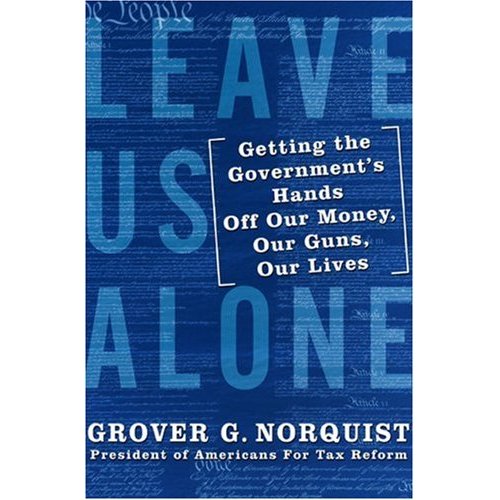
Andronicus pointed this out in the comments to the last post. Apparently the Bush Administration allowed issued an executive order giving them the authority to block the property interests of those it deems to commit acts of violence that undermine our efforts in Iraq. Sure, the order focuses on acts of violence, which should be punished, but the (GINORMIGANTUAN) problem is that it also gives them the authority to block the property rights of those who "materially assist" in such acts. Does that mean that those who protest the war, say we should pull out, or even vote for people who say such things materially assist (after all, they give encouragement to insurgents who commit the acts of violence undermining the peace and stability in Iraq as well as our reconstruction efforts)? How direct of causation are we talking? You can bet that the executive branch will push for as weak of causation as possible. Scary thought.
Here's something scarier: No major news source seems to have picked this up. We must be quite used to the erosion of due process and the danger to civil liberties in the name of security by now.
Friday, July 20, 2007

Thursday, July 19, 2007
War and individual rights
 (Programming note: one of my primary universalized health care sparring partners emailed me to say he will be unavailable for a bit; we shall resume that debate once he returns)
One of the reasons I describe myself as a "small-L libertarian" and am still a member of the GOP (I know, but really, I DON'T think it will change if we abandon it to the fundies) is foreign policy. I don't blog about it much here, but I am pretty Hawkish. I am not out-of-hand opposed to preemptive war (I only wish we had gone after Iran instead of Iraq--just one letter's difference!), and certainly support a defensive one. I am, however, uncomfortable with Wilsonian crusades aimed only at "spreading democracy;" I would like to see a more direct national security interest behind my wars. Now this is not a post about Iraq, but rather whether these principles mesh with my claims of supporting liberty.
Randy Barnett recently published an Op-ed in the WSJ (my favorite NY newspaper!--hat tip to a reader who wishes to retain anonymity) arguing that while many libertarians opposed the war in Iraq a position favoring individual rights is not necessarily incongruent with support (at least at the outset) of the war with Iraq:
Other libertarians, however, supported the war in Iraq because they viewed it as part of a larger war of self-defense against Islamic jihadists who were organizationally independent of any government. They viewed radical Islamic fundamentalism as resulting in part from the corrupt dictatorial regimes that inhabit the Middle East, which have effectively repressed indigenous democratic reformers. Although opposed to nation building generally, these libertarians believed that a strategy of fomenting democratic regimes in the Middle East, as was done in Germany and Japan after World War II, might well be the best way to take the fight to the enemy rather than solely trying to ward off the next attack.
However, in short order Glenn Healy posted on Cato-at-Liberty (the Cato blog) has some respectful though critical words in response to Professor Barnett. Among them:
Is libertarianism really a political philosophy that tells you what to think about mandatory recycling and restrictions on the interstate shipment of wine, but has virtually nothing of interest to say about when it might be morally permissible to use daisy cutters and thermobaric bombs?
And while Healy goes to say that "libertarianism and Wilsonianism don't mix;" I'm not sure that Barnett would disagree. Indeed I agree very much with that sentiment. So how do I reconcile my hawkishness with my limited government rhetoric? Let me try.
 I have a deep distrust of government; therefore, I prefer less of it in my life. That's where many of my libertarian policy positions on domestic issues originate. That said, I trust foreign governments even less than my own. My own government, at least in some small way, is marginally answerable to me. The Japanese Parliament, for instance, is not answerable to me at all. I suppose that means that with regards to international relations I am something of a realist. Given half the chance I think any state wouldn't think twice about oppressing me if it meant more security, economic or military power for them.
 So I happen to think in order to preserve my right to order my daily affairs as I see fit, I need someone to protect my rights of life, liberty and property. So I am no anarchist; i am fine with a police force and court system that punishes people who infringe the rights of others (or perhaps help balance conflicting rights). I think that also includes a government that protects me from other governments that would infringe those rights. So we are still on track when it comes to defensive wars: someone attacks, they have violated the rights of life, liberty or property of citizens, so it appropriate for a government to respond.
What about preemption? Is it appropriate for us to neutralize a danger with military force before it infringes our rights? That's a tougher question. If I answer yes, how do I distinguish between a government preempting an international threat with one that say imprisons people because they look like they might commit a crime? If I answer no, then I say that I require my government to wait for death of its citizens before it protects the rest? I want to answer yes, so here is my attempt at rationalization (this is well open for discussion, I hope people will participate and even call me out if I am inconsistent!).
First, we do punish people before they commit crimes: we call them attempt crimes. Nonetheless, that is not a satisfying answer even to me. Another option is to take the morally dubious position that a government only owes any protection to its citizens. That takes my premise (a government will care about the rights of at most its own citizens) and normalizes it (a government shouldn't care about the rights of those who are not its citizens). Really it boils down to "Who cares about 'em if they ain't 'MERICAN?" I don't like that much either, and I do not people to think that I am going to that practically sociopathic extreme.
Here's what I am working with now: if the realist paradigm accurately describes the international arena, then each actor in that arena is going to try to acquire more security and power, and unlike economic arrangements those are rather zero-sum. If I am relatively more secure then someone is relatively less secure. And part of securing my rights is ensuring that my government is able to continue doing so, which means it needs to be as secure as possible from international threats and part of that is neutralizing threats before they do damage. Does that work? Really, right now I am just thinking out loud (is there an analogous expression applied to writing?), and I'd appreciate your comments.
UPDATE: Barnett responds to critics here. It must be emphasized that neither he nor I am justifying the Iraq war (I feel the time to do so credibly has slipped away forever), but that he and I are talking about libertarianism and war, using Iraq as a context for showing that libertarians can disagree about war without being intellectually dishonest. However, because none of the points to which Professor Barnett responded came up here, I am only linking it for journalistic purposes.
Tuesday, July 17, 2007
Back and better than ever!
Or at least just back :)
I had a great time on my trip, and it made me decide that one day I want a lake house. And a baby (there was this adorable 7 month old on my trip with me!). I will have neither any time soon.
That's the good part; now the less comfortable part. I was with some friends from college, none of whom I have told I'm gay. At one point joking around with one of my friends, I made a lewd reference. And his reaction was mock disgust, and I, playing along, asked innocently "cross a line?" I suppose just to assure me that his reaction was in jest he said "there are no lines between us." Except he's wrong. He may not know it (maybe he does--people are never very surprised when I come out to them), but I am keeping something huge from him and the others on the trip (hmm, putting it that way sounds a little risque).
It reminded me that being secretive and in the closet feels really dishonest. Of course instead of using the moment or the weekend to be honest, I chickened out and just forced myself not to think about the whole matter. I made a mental note to bring it up on the blog and otherwise just put it out of my mind. The closet makes you good at that.
It also reminded me that being out this summer is still an experiment. It's going well, but I still have a lot of work to do. That's what it feels like: work. I'm still not quite ready to roll up my sleeves.
Anyway, folks, I'm ready to discuss health care with you again. Bring it on! :)
I had a great time on my trip, and it made me decide that one day I want a lake house. And a baby (there was this adorable 7 month old on my trip with me!). I will have neither any time soon.
That's the good part; now the less comfortable part. I was with some friends from college, none of whom I have told I'm gay. At one point joking around with one of my friends, I made a lewd reference. And his reaction was mock disgust, and I, playing along, asked innocently "cross a line?" I suppose just to assure me that his reaction was in jest he said "there are no lines between us." Except he's wrong. He may not know it (maybe he does--people are never very surprised when I come out to them), but I am keeping something huge from him and the others on the trip (hmm, putting it that way sounds a little risque).
It reminded me that being secretive and in the closet feels really dishonest. Of course instead of using the moment or the weekend to be honest, I chickened out and just forced myself not to think about the whole matter. I made a mental note to bring it up on the blog and otherwise just put it out of my mind. The closet makes you good at that.
It also reminded me that being out this summer is still an experiment. It's going well, but I still have a lot of work to do. That's what it feels like: work. I'm still not quite ready to roll up my sleeves.
Anyway, folks, I'm ready to discuss health care with you again. Bring it on! :)
Tuesday, July 10, 2007
Programming Note
 Right after I wrote a long post about a controversial topic, I will be skipping town. I have been planning this trip for sometime and on Thursday I fly to the middle of nowhere without access a computer until probably Tuesday.
I'll check back and respond to comments tomorrow evening, but please don't be disappointed if this is my last actual post for about a week.
(For Tim:) I'm Not Buying Free Health Care
Looks like this election cycle, health care is going to be the primary domestic issue. It is one that gets at the very core of what is just and what is American. it is an issue that almost everyone has a strong opinion on, but (unlike say, abortion) one where there is room for dialogue. For those reasons, I am writing what may turn out to be the first in several posts that seriously contemplate the issue of universal health care. So there is no confusion: I'm against it.
Whether we have a public or a private health care system (or a mixture) is basically a question of equity versus efficiency. One can ration health care (and one must, because it is a scarce resource) any number of ways, but the two ways most prevalent are by need or by value.
Universal health care systems ostensibly are about allocating according to need. For instance, a person poor enough to be unable to afford health care may get a deadly, though curable, disease and need a doctor's attention more than a rich person who is getting surgery to correct annoying but not debilitating knee problems. Public health care systems would likely choose the more serious disease over the less serious knee trouble. It seems unfair to many if not most people that the rich person gets his knee problem fixed while the poor person dies. In a need based rationing system, the person who needs the health care most gets it, regardless of ability to pay. If you want to see this, you don't have to go to Cuba, your local emergency room is a perfect example.
Then there is rationing by value, the way a free market system works (which incidentally is not the system we currently have in health care in the United States: government regulation and what may be anti-competitive practices in the insurance industry [I don't know for sure if there are anti-competitive practices, but the current outcomes seem consistent with a lack of competition] distort the market a great deal). In a value system, the person who values the Doctor's time more, as evidenced by a willingness to forgo alternatives (i.e. pay for the health care instead of something else), gets the health care. A market is established and suddenly providers have a profit incentive to be more efficient, to provide both better and faster health care than competitors. Better health care attracts more customers, and faster health care allows providers to service more customers. This is efficiency. Don't forget rich people get cancer just like poor ones (though I do not foreclose the idea that some ailments affect poor people disproportionately, but the treatments developed for different, but perhaps similar "rich people diseases" would be useful and effective in treating "poor people diseases").
Which do we value more? I value efficiency, or more precisely I value EFFECTIVENESS; even if it means that Diamond Jim Millionaire sees the doctor before I do, I'm happy to reap the downstream effects of richer people spending on health care once I do see the doctor. However, I won't deny the sense of injustice that I (yes, even I) felt in the film John Q when that cute little boy couldn't get a heart transplant just because his father was poor. So I am keenly aware of this tension between equity and efficiency, but my argument is summed up thusly: if you focus entirely on equity you lose the great benefits of efficiency (effectiveness).
Now, you may be thinking, "That parenthetical about health care in United States not being a free market was a useful dodge," but actually it wasn't. It was an attempt to establish common ground. I know there are problems with health care; however, I don't think our problems are so much a market failure, but are instead the result of a hindered market. Nonetheless (and here's why it's not a dodge) even if out market is imperfect, it more closely matches the kind of value based health care I was talking about. You have doctors competing for customers who can pay(because they are insured) and becoming more efficient for all (even the uninsured consumers who end up in the emergency room).
Now my argument is premised on the assumption that value based health care results in more efficient health care than does need based health care. Sure I can draw all the analogies I want to justify this (computers, education, almost anything!), but in order to honestly deal with this assumption I have to look at the health care industry itself. Primarily, I will examine the quality of health care in the U.S. compared to other countries, focusing primarily on effectiveness. From this I make the inference that we have a higher quality of health care (FOR THOSE WHO GET IT) because our value based system is more efficient. If that is not rigorous enough for please tell me what would be and I will try to comply in the future.
Generally speaking the quality of health care in the untied states (FOR THOSE WHO GET IT) is respected worldwide [Right Column, Page 11] (though things can always improve!). This study suggests that in the Untied states the quality of health care exceeds that of other countries [see charts, pages 3, 4, 5, 12]. (this naturally excludes emergency rooms where the care is rationed based on need--emergency rooms are required by law to see any patient regardless of ability to pay). Americans seems satisfied with their health care: The chart on page 93 indicates that 72% of patients think hospitals are doing a good job, and 84% were satisfied with their last visit to the doctor. Notice also that the lowest area of satisfaction cited has to with insurance.
Even articles critical of the U.S. Health Care System seems to show that we have a high quality (effectiveness) even if we are dissatisfied with other aspects of out health care system:
Even articles critical of the U.S. Health Care System seems to show that we have a high quality (effectiveness) even if we are dissatisfied with other aspects of out health care system:
The U.S. system ranked first on effectiveness but ranked last on other dimensions of quality (Figure ES-1). It performed particularly poorly in terms of providing care equitably, safely, efficiently, or in a patient-centered manner.
When it comes to medical innovation, the United States is the world leader. In the last 10 years, for instance, 12 Nobel Prizes in medicine have gone to American-born scientists working in the United States, 3 have gone to foreign-born scientists working in the United States, and just 7 have gone to researchers outside the country.
Indeed almost all dissatisfaction and criticism of health care in the United States that I could find had to do with ACCESS not QUALITY. The only problem is if you just mandate access and fix prices, as in a single payer system, you reduce incentives to invest in innovation and maintain quality. we lose that edge. "But wait one second, Pinky," I hear you say in your skeptical of the market tone of voice, "isn't a lot of the fantastic medical research in the United States funded by public money such as grants?" Yes, but remember, the grant provides only the cost of research the incentive is in the patent which will bring you profit. (Sometimes just glory, but I'll bet most of the time profit is quite enough incentive!).
What about U.S. life expectancy? It seems true that the U.S. population consistently has a shorter life expectancy compared to other developed countries. If health care is all about prolonging life, then surely this fact indicts my premise that U.S. health care is more effective, right? Wrong. Sure health care quality and effectiveness will have an impact on life expectancy at the margins, but we cannot forget all the other things that contribute to a national population's average life expectancy. Perhaps things like crime, suicide, auto accidents have something to do with it. Then there's population size, geographical diversity and racial composition (yes different races have different life expectancies!). And let's not forget the big one: LIFESTYLE. The fact that our diabetes rates are rising is not because our hospitals suck, it's because we are fat and lazy. Universal health care is not going to change that.
People are so eager to get to a fairer system they forget that the quality of health care in this country is at an amazing level. It find it not only intellectually unpersuasive but also dishonest when people try to portray American health care quality as substandard (often ignoring the difference between emergency and nonemergency care--I cannot stress that point enough--or including access, a real problem, as a measure of quality) in an effort to bring us efficiency folks into the equity side. The problem is not the quality of what we get; the problem is who gets it (or more accurately who doesn't).
So what do I suggest instead? I'll probably develop this in a later post, but a deregulation of the insurance industry might be a start. Similarly, if you MUST have the government subsidize health care, you should do it in a way that keeps competition. I support school vouchers, so maybe health vouchers would be a way to go.
So what do I suggest instead? I'll probably develop this in a later post, but a deregulation of the insurance industry might be a start. Similarly, if you MUST have the government subsidize health care, you should do it in a way that keeps competition. I support school vouchers, so maybe health vouchers would be a way to go.
Look for Part 2 where I discuss the economics of 2 tiered systems (the more likely result in this country anyway), and why they are just as bad (even in France!).
Join the Club
 You too can join the Anti-Universal Coverage Club. (I know you probably won't because I don't think many of my readers are actually as free market gaga as I am). Regardless, here are it's basic principles:
- Health policy should focus on making health care of ever-increasing quality available to an ever-increasing number of people.
- To achieve “universal coverage” would require either having the government provide health insurance to everyone or forcing everyone to buy it. Government provision is undesirable, because government does a poor job of improving quality or efficiency. Forcing people to get insurance would lead to a worse health-care system for everyone, because it would necessitate so much more government intervention.
- In a free country, people should have the right to refuse health insurance.
- If governments must subsidize those who cannot afford medical care, they should be free to experiment with different types of subsidies (cash, vouchers, insurance, public clinics & hospitals, uncompensated care payments, etc.) and tax exemptions, rather than be forced by a policy of “universal coverage” to subsidize people via “insurance.”
Like I told my new BFF Andrew Tobias, I don't want every trip to the doctor to be like a trip to the DMV--or the emergency room. Though I stick to my economic guns (principle number 2), an interesting and quintessentially libertarian take on this is principle number 3. (Also number 1, here, although many other good points as well). I hadn't quite considered that an actual personal liberty argument can be made. Nonetheless, the sad thing is others won't find it very compelling; I fear that the "Government has a DUTY to take care of me" mindset is alive and growing (damn you, FDR and LBJ, damn you!).
Update: Kip Esquire makes an exceptional point: why do we trust the government to be better at spending on healthcare than say, it is on antiterrorism grants? Excerpted:
So the question becomes: If the federal government can't get spending on domestic security "right" (I refuse to use the fascistic word "homeland" except as part of a proper noun), then why should the healthcare socialists expect the federal government to get spending on health care "right"?
All the same indignation would emerge under socialized medicine: "Why does cancer get more than heart disease?" "Why do New York City's research and teaching hospitals get so little?" "Why does white suburban geriatric nursing get more than black inner-city pediatric nursing?" "Why are 'homosexual diseases' covered at all?" "Why is Viagra covered but not Propecia?" "Why does my neighbor's kid get a motorized wheelchair while my kid gets crutches?" "Why is there a huge hospital at the other end of the Bridge to Nowhere?" And so on.
* * *
Socialized medicine would be a never-ending political haggle based, not on objective metrics, but on the Politics of Pull, balanced out by the Politics of the Warm Fuzzy Feeling, perhaps with some racial, gender and sexual orientation inequities tossed in for flavor.
And the worst part? People would suffer and die from it -- in needless, senseless ways that a terrorist could only dream of.
And Tim, I promise I'll add my own thoughts soon.
Monday, July 9, 2007
My new best friend Andy
 I just got an email from Andrew Tobias (well, yes, it was a two line response to one I sent him, but do you have a personal letter from the treasurer of either the DNC or RNC? I didn't think so). Mr. Tobias, apart from being a mover and shaker, also wrote The Only Investment Guide You'll Ever Need, and more importantly The Best Little Boy in the World, which I found incredibly comforting as I contemplated my own coming out. For that reason, besides his political clout (but in the WRONG party!) and his financial advice, his little nod is especially meaningful to me.
Also, he seemed to think I would be more comfortable in the moderate wing of the Democratic Party. Well, no one's perfect :-)
Subscribe to:
Posts (Atom)